Social Media

Wednesday, 29 April 2015

Capitalizing on Recruitment Potential: FSWEP 2.0

By Patrick Obendoerfer


\\GOA\MyDocs\Health\karan.riarh\My Pictures\FSWEP.PNG

This blog is based on the paper FSWEP 2.0: Recruiting a Motivated Public Service, by Russell B. Ferguson, Patrick Obendoerfer and Anisa Vangjeli, was awarded the grand prize in the IPAC 2015 Blueprint 2020 National Paper Competition.


3 things to know about capitalizing on the Federal Student Work Experience Program’s (FSWEP) recruitment potential:

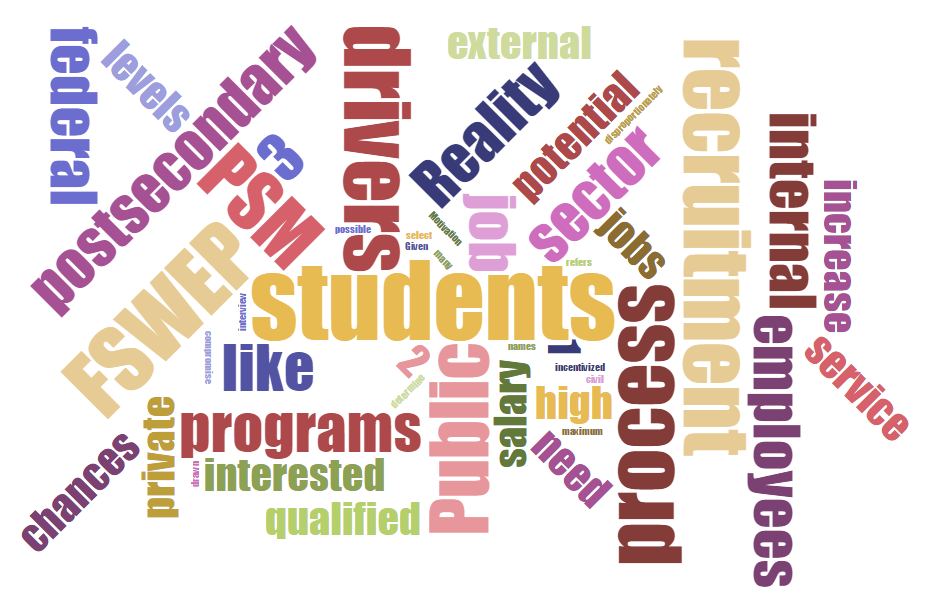
1. The FSWEP draws applications from a pool of 50,000 post-secondary students annually. In the application process, students are asked to select a maximum of 24 interests, which determine if their names are drawn for an interview. Given this, students are incentivized to compromise the process by choosing as many interests as possible to increase their chances. 

2. Public Service Motivation (PSM) refers to internal drivers that are disproportionately high in public servants, like the goal of contributing to society, and exist in addition to external drivers like salary. There is a positive correlation between PSM levels and rates of job attraction, retention, and engagement.   

3. Through an altered application and assessment process that is designed to align PSM satisfying jobs to qualified and interested post-secondary students, the federal government can drastically increase the chances that students will continue with the civil service through FSWEP.


Three myths about innovative recruitment:

Myth #1: New programs must be created, which may be time consuming and expensive.

FSWEP already exposes 50 000 post-secondary students to the job application process. Through relatively inexpensive changes to the process, the federal government can capitalize on the program’s recruitment potential.

Myth #2: Public and private sector employees have identical motivational drivers.

Public sector employees tend to have stronger internal drivers, such as the need to affect societal change, whereas private sector employees are more motivated by external drivers like money.

Myth #3: Recruitment strategies in a competitive job market need to focus on salary.

By aligning qualified and interested students with jobs that satisfy individuals with high levels of PSM, a recruitment strategy through FSWEP can be centred on internal motivators.

Patrick Obendoerfer is a graduate student at the Carleton School of Public Policy and Administration, where he specializes in Public Management. 

Wednesday, 15 April 2015

Resource Revenue Sharing with Aboriginal Peoples

By Ken Coates


Canada is engaged in a debate about the appropriateness of resource revenue 
sharing with Aboriginal peoples. Twenty years ago, the concept had little traction 
outside of Aboriginal circles. Now, resource revenue sharing operates across more 
than half of the country’s land mass. 

Three things to know about revenue sharing:

1. There is no single model of resource revenue sharing. British Columbia 
negotiates arrangements on a project-by-project basis. The Northwest 
Territories shares a portion of its resource revenue among all Aboriginal 
communities in the jurisdiction. Saskatchewan rejects the concept out of hand 
and does not have arrangements in place. In many parts of the North, from 
Labrador to the Yukon, resource revenue sharing is built into modern treaties.  

2. Resource revenue sharing is only part of the financial benefit that accrues to 
Aboriginal communities from resource developments. Collaboration agreements, 
which involve jobs, training and business opportunities, are over and above 
revenue sharing.  

3. Resource revenue sharing is not mandated by the Supreme Court, the 
Constitution or Government of Canada policy. Natural resources are a provincial 
responsibility and the revenues flow to provincial and territorial authorities. It is 
up to the individual sub-national governments to determine the shape of 
revenue sharing.  

Three myths about revenue sharing:

Myth #1: Aboriginal communities will become wealthy from resource revenue sharing 
arrangements on their traditional territories. With most arrangements, this is 
not the case. The money is welcome, but it is smaller than the sums available 
through equity ownership or the development of natural resources on 
Aboriginal lands.

Myth #2: Resource revenue sharing is a response to an Aboriginal veto over resource 
development. It is not. Although Indigenous communities have considerable 
legal and political authority, governments are not compelled to share their 
revenues.

Myth #3: Resource revenue sharing comes from the resource companies. False. Resource 
companies contribute to Aboriginal communities in other ways, and the resource 
revenue comes from the royalties collected by government. Aboriginal people are, indeed, sharing in the wealth generated from their traditional territories, albeit in a typically Canadian patchwork of policy and practice. Revenue sharing is a reality and has played a key role in securing Aboriginal support for resource development.

Ken Coates is Canada Research Chair in Regional Innovation, Johnson-Shoyama 
Graduate School of Public Policy, University of Saskatchewan and Senior Fellow, 
Macdonald-Laurier Institute and the co-Director the Aboriginal People and Natural 
Resources Project.  He is the author of #IdleNoMore (University of Regina Press) and 
the co-author of From Treaty Peoples to Treaty Nation (UBC Press).

Wednesday, 8 April 2015

From #PhDToGov: Jared Wesley's Story


What stereotypes do people have of PhDs? Are these deserved?


Can I challenge the assumption behind the question?  I don’t consider myself to be “a PhD”.  I have one, and keep the degree on my wall at home.  But I am not one.  In this sense, one of the well-deserved stereotypes of “PhDs” is that they are their degrees.  In other words, many people with PhDs have made it part of their identity.  This means more than simply listing it on their business cards and in their email signatures (which I do).  It means identifying themselves as PhDs, either explicitly (“please call me Dr.”) or implicitly (carrying an air of ‘differentness’ if not superiority when interacting with people from other professional communities).   I've even seen it crop up in networking events and casual conversations, as some people with PhDs assume that they've "earned" more than an entry-level position by virtue of spending over ten years in university.  That used to be true, but today's job market is different -- particularly in government, and particularly when it comes to management roles.  Today's employers are looking for practical experience and skills more than traditional academic credentials.  All told, this self-identification "as a PhD" can be off-putting to people outside the academy, whether out of (often undeserved) intellectual intimidation, resentment, professional rivalry, or other reasons.  And it’s one of the greatest barriers facing people who want to transition to alternative-academic (alt-ac) careers.

How useful do you think a PhD is for people working outside the academy?

It really depends, largely on who you have as a PhD supervisor.  Some advisors encourage and even seek out opportunities for their students when it comes to alt-ac professional development and networking.  Others are more insular, focused on the old school (‘publish or perish’ and ‘scholar/apprentice’) approach when it comes to mentoring their students.  The core elements of a PhD program are less important to me, both as a practitioner and as someone in a position to hire recently-graduated PhD students. Coursework may well impart the core knowledge necessary to succeed in the public service, and the research component may impart useful methodological skills (depending on the type of role they assume in government).  Dissertation-writing and publishing are far less important, although the ability to accept and adapt to criticism is a valuable soft skill.

Under what circumstances would you advise a young student who does not want to be a prof to pursue a PhD?


I'd be blunt, advising them to do so if:
  • They are getting paid to complete the PhD.  A wise mentor once told me, “If you’re not getting paid to go to grad school, you’re paying for someone else to go to grad school.”  The ability to secure scholarships and fellowships is more than simply a means to sustain yourself (without amassing student debt).  It is a canary in the coal mine; if people don’t see your academic promise by the time you complete your Master’s, a PhD is not likely the best path for you. 
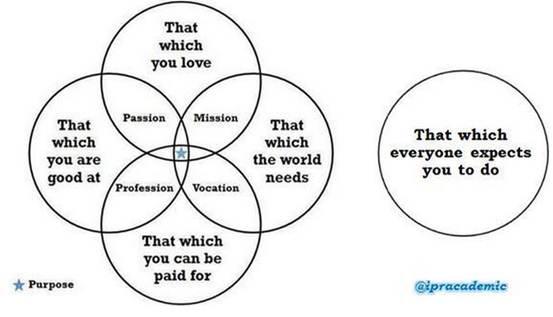
  • They are thinking beyond self-fulfillment.  I often hear students say, “I want to be a PhD.” Or “I want to do it for me, to learn more about x.”  That’s rarely enough, I’m afraid, to sustain yourself through a 4 to 6 year commitment.  I use the following Venn diagram to coach students to think about the relevant ingredients in a fulfilling career – one with purpose:
cid:image002.jpg@01D057ED.A49F66C0


Do PhDs in the social sciences and humanities obtain skills during their studies that serve them well outside the academy? How useful is a PhD when working for government?

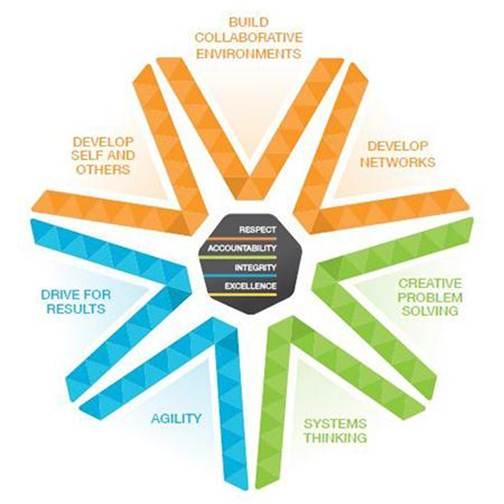
Again, the research skills, and ability to adapt to criticism, are most valuable.  Under-appreciated by grad schools, and under-developed in grad students, however:  soft skills.  These include relationship-building, teamwork, persuasion without authority, strategic planning, collaboration, and the like.  Grad schools would do well to study the key competencies expected by governments in terms of their employees’ development.  Here’s the Government of Alberta’s model, for example.  

APS Compentencies


What should PhD programs do differently, if anything, for those students who are not planning to become full-time academics?


I think the University of Alberta has started well, with their FGSR Advisory Committee on Professional Development (I’m a member).  It invites leaders from various sectors (private, non-profit, public) to share their thoughts with high-ranking university administrators about what they need from tomorrow’s grad students.  The challenge is mobilizing that knowledge, and implementing the recommendations, across all PhD programs at the university.  Ironically, that takes the same sort of soft skills I mentioned above…


Jared Wesley earned his PhD in political science from the University of Calgary. He’s now Director of Social Policy for the Ministry of International and Intergovernmental Relations at the Government of Alberta, adjunct professor of political science at the University of Albertaand pracademic chair of the Institute for Public Administration Canada (IPAC) (Edmonton Regional Group). Find him on LinkedIn, Twitter (@ipracademic), and Flipboard.  You can read more about his career journey here.

Wednesday, 1 April 2015

How do we open the "black box" of civil service accountability?

By Mark D. Jarvis


The accountability of civil service executives, mid-level managers and professionals has been a “black box”. My new research is trying to close this gap in our knowledge by building an empirical understanding of how, and for what, individual executive, managerial and working-level civil servants are held to account, comparing Canada, Australia and the Netherlands.


First three myths that should be dispelled:

Myth #1: The accountability of civil servants doesn’t matter. 

Reality: It does. Civil servants at all levels of government exercise substantial authority and often have a significant impact on how policies are developed, taxes are spent and services are delivered.

Myth #2: Civil servants aren’t held to account. 

Reality: They are. In addition to ongoing informal accountability, nearly all civil servants are subject to at least an annual performance review.

Myth #3: Civil servants don’t get fired, so there is no real accountability. 

Reality: False. Civil servants do, at times, get fired. More importantly, accountability isn’t just about what happens when things go wrong — although that’s obviously important — it’s also about whether day-to-day accountability practices within the civil service meet desired objectives.


Now, three things that you should know about the accountability of civil servants:

1. Civil service accountability can serve a number of different objectives or purposes. Among the most important – and the four this research examined – are democratic control; assurance; learning; and, results.

2. While there is evidence that civil service accountability practices in all three countries focus on all four of these purposes, there is also evidence that accountability practices could be strengthened with regards to each, especially learning and results.

3. The results also suggest there is some tension between different purposes of accountability (e.g., the emphasis on achieving results at times inhibits accountability mechanisms from stimulating greater learning).


How we think about, define and emphasize the different purposes of accountability has a practical implication for how we expect civil servants to do their jobs. We should be thoughtful about what ends we expect accountability to serve, especially as technology mitigates increasingly outdated accountability concerns.

Mark D. Jarvis is the Practice Lead for Government Transformation at the Mowat Centre. His book, Democratizing the Constitution: Reforming Responsible Government, co-authored with Lori Turnbull and the late Peter Aucoin, was awarded both the Donner and Smiley book prizes.

Thursday, 26 March 2015

From #PhDToGov: Alex Ryan's Story


Alex Ryan, Senior Systems Design Advisor, Government of Alberta


Brief Bio

My PhD in Applied Mathematics advanced a Multidisciplinary Approach to Complex Systems Design. I completed my PhD while working full-time with the Defence Science and Technology Organisation as a federal public servant in Adelaide, Australia. In my nine years with DSTO, I led long range research on complex adaptive systems, supported Army operations in Afghanistan, contributed to capstone Army doctrine, and informed large acquisition decisions through research, modeling and analysis. Following this, I worked for Booz Allen Hamilton in Leavenworth, US for five years. As a consultant, I taught at the graduate level at the School of Advanced Military Studies and worked with Strategic Command, Special Operations Command, Cyber Command, and the Joint Staff in applying systems thinking and design to global strategic challenges. In 2014 I moved to Edmonton to found and lead Alberta CoLab, a cross-ministry systemic design and strategic foresight lab within the Government of Alberta.


What did you hope for in terms of employment as you completed your PhD?

I was already working full-time as a public servant when I began my PhD. I saw my PhD as a pathway to a different quality of work and a different kind of career progression. I was motivated to progress but had little interest in project or people management. The PhD was a way to advance within an applied scientific organization without taking on management responsibility. I also expected that a PhD would open up opportunities to work internationally, and this has certainly been borne out.


Why did you choose an alternative-academic career path?

I was already on an established career path when I started my PhD. While I have always been attracted to theory and research, and have been surprised by how much I enjoy teaching, these have always been deeply grounded in application for me. I have found it easier to connect theory and practice by operating within organizations that are immersed in real world challenges.  


What do you do now?

I convene diverse and conflicting groups of stakeholders around the most complex and ambiguous challenges facing the Government of Alberta and guide them through a systemic design process to arrive at robust and innovative options for systems change. This is a brand new capability for the Government of Alberta, and unique in the Canadian public service. In the last year, our team led 62 workshops across 38 projects, with 14 different ministries in the lead. This resulted in new organizations, frameworks, strategies, and services for Albertans. My PhD in complex systems design provides me with a depth of knowledge that enables agility during dynamic group co-design processes. It also provides a degree of assurance to participants to trust in a process that is often uncomfortable and counter-intuitive. Even though there is no mathematics in my work, I see my theoretical training as providing me with a capacity for abstract thought that is extremely useful when moving between problem sets as diverse as military strategy, resource management, climate change, early childhood development, and health system transformation.   


What’s the most challenging part about a pracademic career?

Organizational incentive mechanisms, structures and supports are designed to encourage specialization. Whether you choose to operate on the academic or the practice side of this division of labour, there is a cost you will pay for operating in the interstitial space. As an academic, applied case studies are less valued than basic research. As a practitioner, you will be seen as over-complicating things, asking inconvenient questions, and wasting time on intellectual curiosities. I think the cost is worth it, because I believe the most interesting problems are precisely in this interstice.


Speaking from my experience operating on the practical side of the divide, the way to overcome this challenge is to be creative in how you maintain the space for reading, researching and writing. In my first job, starting my PhD was the way to create this space. In my jobs with the Government of Alberta and Booz Allen Hamilton, I have worked at 80-90% full time to give myself a “Google Day” for personal research projects. Without this continual research time, I think the deep knowledge I gained through my PhD would have eroded, rather than expanded.


What most surprises you about your job?

How intelligent and curious the public servants I work with are. It has been my experience across three countries and military and civilian service that the stereotypes are profoundly misleading.
What advice or thoughts do you have for graduate students and post-doc students in transition now?
Your PhD will get you noticed, but don’t expect it to give you an edge in climbing the ladder, because the ladder has not been designed with you in mind. Instead, use your PhD to take you laterally across many organizations to add breadth of experience to your depth of knowledge. I doubt the motivation for your PhD was career advancement, so don’t get caught up chasing the standard career progression model. Think deeply about where you want to go and then cut your own path to get there.

Wednesday, 25 March 2015

From #PhDToGov: Navigating Alt-Ac Careers in the Public Service

The Edmonton Regional Group of the Institute of Public Administration Canada (IPAC) is committed to developing a stronger “pracademic” culture in Canada, by building a network of practitioners and academics to discuss the most challenging issues facing the public service. We are also committed to building bridges across the traditional divide between the scholarly and public service communities.

As part of this commitment, we are introducing a new component to the IPAC Impact blog.  Entitled #PhDtoGov, this series highlights the unique and varied career paths of “pracademics” – those whose educational and work experiences span the divide between the ivory tower and government.  This format is based on the highly popular “From PhD to Life” blog found on the University Affairs website, only with a specific focus on public service careers.

In particular, we’re asking pracademics to answer questions like:

  • What did you hope for in terms of employment as you completed your PhD?
  • What was your first post-PhD job?
  • Why did you choose an alternative-academic (alt-ac) career path?
  • What do you do now?
  • What’s the most challenging part about a pracademic career?
  • What most surprises you about your job?
  • What advice or thoughts do you have for graduate students and post-doc students in transition now?

If you’re an undergraduate or graduate student examining career options, a post-doc seeking a new career path, or an academic looking for a change in careers, stay tuned to this blog (and follow us on Twitter, @ipacimpact).

If you’ve got a career story to tell, let us know!  We’d be happy to post your interview here on the IPAC Impact blog.

Monday, 23 March 2015

How do we boost youth turnout in Canada?

by Ilona Doherty


Three things to know about young Canadians and voting:


1.  In the 2011 Federal Election only 38.8% of Canadians aged 18-24 voted, continuing a long-term downward trend in Canada and throughout most of the western world of young people not opting into the democratic process. 
2.  Voting – or not voting – is a habit. If a young person doesn’t vote in the first two elections when they are eligible, they are less likely to vote throughout the rest of their lives. 
3.  If we don’t address this issue, in a generation we will have a country where the majority of citizens don’t vote. To begin tackling this problem, first we need to dispel a few myths about young people. 

Three myths about young Canadians and voting:

Myth #1:  Young people are left leaning in how they vote. 

Reality:  In the US “for most of the past four decades there was little difference in the voting preferences of younger and older Americans” a Pew Research Centre study concluded. Research clearly shows us again and again that young people tend to vote like their parents. All political parties should consider young people as a potential voting base.

Myth #2:  Young people are more cynical about politics than their elders.

Reality:  When it comes to being cynical about politics young people and their parents don’t agree.  Research tells us that young people are actually more optimistic than their elders. We don’t need to convince young people that voting is important, we just need to support them in getting out to the polls.

Myth #3:  Social media is the solution to this problem.

Reality:  Asking a young person to vote in person increases the likelihood that they will vote by 10% and is by far the most effective method.  Reversing a long-term trend isn’t easy, but organizations like Apathy is Boring will be working hard in 2015 and beyond to ensure that the next generation of Canadians becomes a generation of active citizens.


For more on this issue, attend a presentation by Ilona Dougherty, President & Co-Founder of Apathy is Boring, brought to you by the Peter Lougheed Leadership College in conjunction with the University of Alberta Students’ Union.

Monday, March 23, 2015
4:30 – 5:30 PM
1-190 Edmonton Clinic Health Academy
University of Alberta Campus


As seating is limited, advanced registration is recommended: http://goo.gl/forms/3q3Bt3oBhg


A lifelong social & public policy innovator, Ilona Dougherty’s diverse experiences range from being a Canadian delegate to a United Nations conference at 17 years old to working with youth in a small community above the Arctic Circle. In January 2004, Ilona co-founded Apathy is Boring (www.apathyisboring.com), a national non-partisan charitable organization that uses art and technology to educate youth about democracy and encourages them to vote. Ilona is a regular commentator on CTV News Channel and Ipolitics.ca, and speaks to audiences internationally about redefining intergenerational relationships, changing the way we think about young people, and encouraging active citizenship.